Biodiversity Across Four National Parks
The goal of this project was to draw conclusions from data concerning species observed in four National Parks in the United States. The four parks included Yosemite, Great Smoky Mountains, Bryce, and Yellowstone. The observations of the species included information concerning how many observations of a species had been recorded at a particular park. A separate table of species included information regarding scientific names, common names, conservation statuses, and category of species.
Once examined, the important data was identified as all data related to species that had a defined conservation status in the species table because the author wished to draw conclusions about what conservation statuses different species have and how that is connected to the number of sightings reported in the parks. One hundred seventy nine (179) species had non-null conservation statuses, so the data was restricted to those species in both the observation and species tables. Further, the species table had the scientific name expanded to be able to see if a particular genus was more affected than others. The observation table was then modified such that each species had only one row containing how many sightings there had been at each park. An inner merge was performed using the scientific name to end with a single table for analysis.
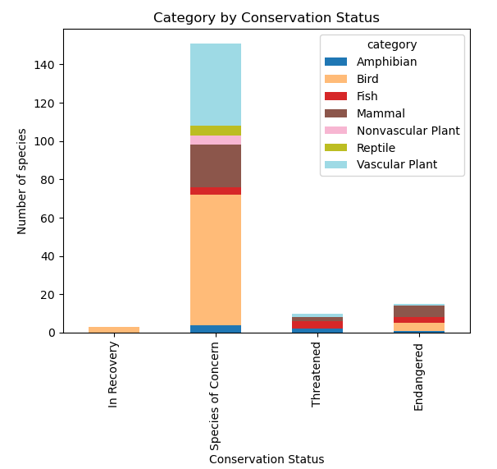
It was found that a large majority of species had the conservation status of Species of Concern. The three largest affected categories were birds, vascular plants, and mammals. Analysis of the conservation status by genus found that the genus Myotis had the most separate species represented with conservation statuses. The genus Myotis refers to the bat, so it can be concluded that national parks are maintaining environments in which bat populations may be able to recover. Overall, national parks are safe havens for at-risk species, and expanding the ecosystems that we see in these parks could help to give these species a better chance at survival.